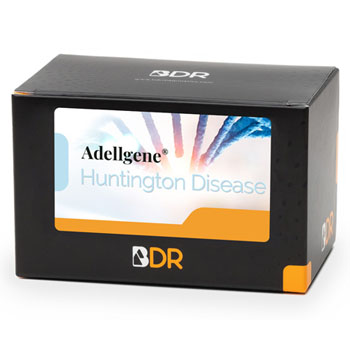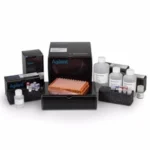
Kit for the determination of the CAG triplet repeats number of the HTT gene by fluorescent fragment analysis
Information about the product
Huntington Disease (HD) is a progressive disorder of motor, cognitive, and psychiatric disturbances. The disease is inherited in an autosomal dominant fashion and is caused by the expansion of CAG trinucleotide repeats located in a gene termed Huntingtin (HTT, originally known as IT-15). This trinucleotide codes for the aminoacid glutamine.
A normal allele for gene IT15 contains 10-26 CAG repeats. Individuals with 27-35 repeats fall into the intermediate range, and their children are at risk of HD. The abnormal range varies between 36-121 alleles; individuals at the bottom of this range may or may not develop symptoms of HD. Expansions greater than 60 repeats result in juvenile onset, while expansions between 40 and 55 repeats induce adult onset
Intended use
Adellgene® Huntington Disease (HD) is a semi-automated in vitro diagnostic kit designed for use in clinical laboratories, for the quantitative determination of the number of repetitions of the CAG (cytosine-adenine-guanine) triplet, located on exon 1 of the IT15 gene (HTT), which can result in the formation of Huntington’s disease, also called Huntington’s Chorea. It aims to aid the clinical diagnosis associated with Huntington’s chorea, such as: subtle changes in coordination, involuntary minor movements, difficulty mentally planning, and often a depressed or irritable mood.
The use of this kit is for the determination of both healthy and unhealthy alleles, who have between 10 and 35 repetitions or more than 36 repetitions, respectively. Heterozygous and possible homozygous alleles with a size equal to or less than 121 CAG repeats are quantified. Possible alleles bigger than that size would be identified because of their pattern.
The technology is based on the triplet repeat primed polymerase chain reaction (TP-PCR) of genomic DNA extracted from peripheral blood, followed by fluorescence analysis of the size of the PCR fragments obtained by the genetic analyzer and conversion of that size into the respective number of CAG repeats. Moreover, the observation of the pattern of peaks allows to identify expanded alleles and to confirm the samples with homozygous normal alleles.
Patients who can benefit from this determination are those referred by a specialist. The intended user of the kit is technical personnel trained to carry out the protocol and the interpretation of results described in the instructions for use.
Workflow

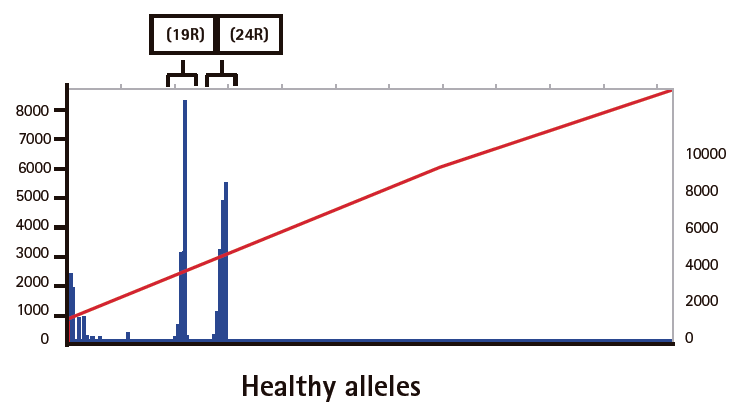
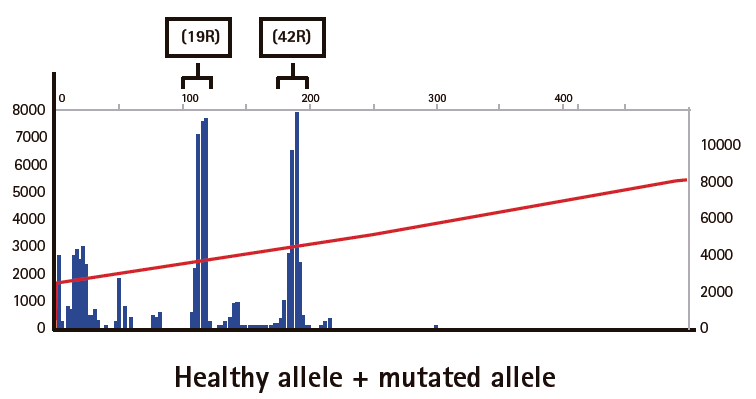
Results
Limitaciones
- Mutations (point mutations, insertions, deletions) at amplification primer sites are possible and may result in the lack of allele definition. Other technologies could be necessary to resolve the genotyping.
- Data and result interpretation should be revised by qualified personnel.